

Agriculture Insurance Scheme for Horticulture Farmers in Uzbekistan
Tripartite agreement programme
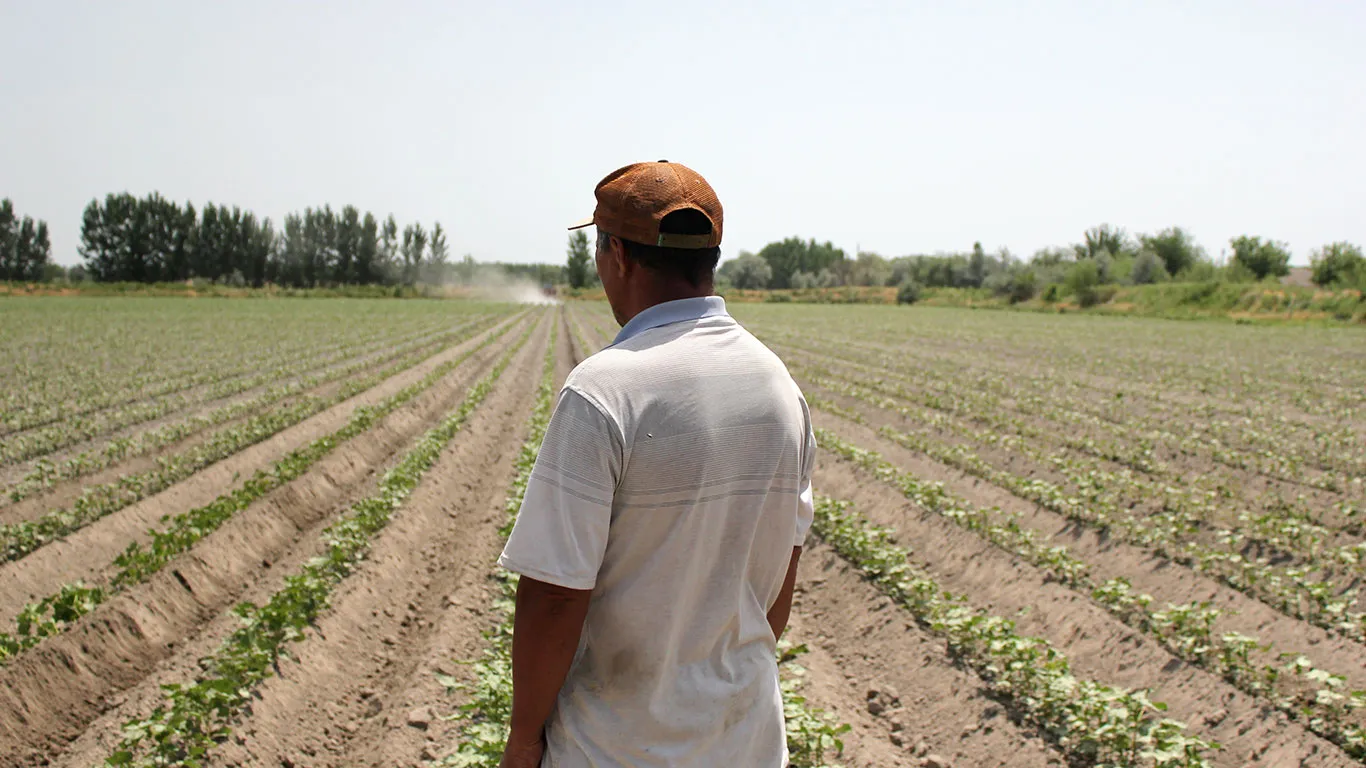
A Public-Private Partnership Enhancing Climate Disaster Resilience
Agriculture plays a crucial role in Uzbekistan’s economy, accounting for approximately 25% of the national GDP and employing about 26% of the labor force. Uzbekistan’s smallholder horticulture farmers are highly vulnerable to climate-induced disaster risks. The spring frost risk is of big concern, and it is increasing due to climate change. The winters are getting warmer and the crops become more vulnerable due to lack of winter hibernation.
This Tripartite insurance project addresses the protection gap through tailored climate disaster risk insurance, delivered through local insurers and supported by international expertise and premium subsidies. It is designed to scale, strengthen domestic insurance markets, and integrate climate resilience into national policy.
The protection gap
Among the agricultural sector, dehqan farmers – otherwise known as smallholder farmers – occupy 13% of the cultivated land, and contribute 65% to the country’s gross agricultural output. This heavy reliance on agriculture through smallholder farms makes the country highly susceptible to climate risks and natural disasters.
Horticulture farmers have been confirming the increase of losses from spring frost in recent years. Additionally, climate change brings a higher vulnerability to the irrigation supply and in stronger heat waves that are especially harmful for the fruit crops at flowering and early fruit development stages.
Uzbek smallholder horticulture farmers’ vulnerability to climate-induced disaster risks threatens crop yields, livelihoods, and national economic stability. Insurance penetration is low, and risk transfer mechanisms have historically been limited.
The insurance solution
The insurance covers six key crops across five regions with the Government of Uzbekistan, through the Ministry of Agriculture, subsidizing 50% of the premium cost to make the insurance protection more accessible to climate-vulnerable horticulture farmers.
The insurance scheme is designed to be effective and inclusive, granting smallholder farmers access to insurance and increasing their resilience to climate disaster risk.
Insured Asset
Initially fruits (apricots, cherries, grapes) and vegetables.
Insured peril / hazard
Multi-peril: Spring frost, wind, hail, flood, fire, failure of irrigation and pests/diseases.
Geographic focus
Fergana valley (Fergana, Namangan and Andijan oblast).
Policyholders
The policy holders are and will be the Uzbek smallholder farmers (majority Dehqan farmers with less than 2 hectares field size, and commercial farmers), with a 50% subsidy of the premium costs by the Government of Uzbekistan through the Ministry of Agriculture.
Estimated Beneficiaries
- 16,910 farmers and their families will benefit from the product initially.
- When the scheme is expanded to other crops, it is expected to benefit up to almost 260,000 people, of which almost 95% are poor and vulnerable.
Claims Payouts
Information coming soon.
Other project benefits
- Analysis of weather and yield data.
- Development of underwriting and loss adjustment guidelines.
- Market assessment of current legal, regulatory and insurance framework – and support in developing a new agricultural insurance law.
- Risk and insurance awareness raising for farmers.
- Capacity building for local insurers, adjusters and government stakeholders.
- Strengthened technical capacity within local insurance companies supports sustainable market growth without relying on external experts.
Project impacts
- Increase resilience of farmers from the horticulture sector against climate disaster risk.
- Enhance the government’s ability to respond to disasters in a timely manner and reduce the financial burden by leveraging private capital.
- Strengthen the Uzbek agricultural insurance market.
Project Timeline
Project Launch: August 2023.
Product Delivery & Project Pilot Launch: April 2025 The agriculture insurance products were presented to local insurers’ sales force, government agencies and local farmer organizations to mark the start of and stimulate the sales process.
Project Formal Close: August 2025.
Project implementation cost
Approximately EUR 1.9 million, co-funded by the participating IDF industry members and the German Government through the InsuResilience Solutions Fund (ISF).
Programme Partners
The partners of the Tripartite Agreement Programme are:
- German Federal Ministry for Economic Cooperation and Development (BMZ), through the InsuResilience Solutions Fund (ISF).
- Insurance Development Forum (IDF).
- United Nations Development Programme (UNDP).
Uzbekistan Project Partners
- Ministry of Agriculture.
- National Agency for Prospective Projects (NAPP).
- Hydrometeorological Service Centre.
- Association of Professional Insurance Market Participants.
- Uzagrosugurta (State-owned Uzbek insurance company).
Private Sector IDF Project Members & Partners
- Europa Re
- Swiss Re
- Semurg (Uzbek private insurer)
Key learnings from the Project
Delivered by project team members
Creating a shared understanding
Agricultural insurance sits right at the crossroads of finance, agriculture, economics, and climate science, so at the beginning everyone came with their own perspective. Government institutions were focused on protecting farmers, insurers were focused on financial sustainability, development partners brought international standards, and technical experts looked at scientific accuracy. Our biggest task was to bridge these perspectives.
What really stood out was how naturally the different sectors aligned once we created a common language and understanding.
Importance of of communication
We invested a lot of effort into structured communication and continuous information sharing. This wasn’t just about presenting materials — it involved translating concepts across sectors, simplifying technical elements, and explaining why each piece mattered for the success of the scheme.
In a project that brings together so many different sectors — government, insurers, agronomists, development partners — clear and patient communication can make the difference between progress and misunderstanding. We learned that technical knowledge alone is not enough; what really drives success is the ability to translate that knowledge in a way that resonates with each stakeholder.
Combining scientific rigor with respect for local practices
An important learning was the value of combining scientific rigor with respect for local practices. When the IDF team approached the work with evidence, transparency, and consistency — while also acknowledging local experience and traditions — partners on the ground showed much stronger engagement and trust.
Timely target group awareness raising and marketing are key
In this case a campaign was run by the involved local insurers and the Ministry of Agriculture, which started already in spring 2024. Our local partners noticed sincere interest from the farmers and increased risk awareness. Even after the insurance sales window was closed, farmers kept approaching insurers and the Ministry of Agriculture pointing to the climate patterns that were damaging to the crop.
Key to scaling the program and increasing sales is the timely start of marketing and sales activities and the timely confirmation of government subsidies.
Insurance Market Strengthening
Historically, the Uzbek insurance market operated under a more traditional structure. Through this initiative, we introduced modern, internationally aligned approaches — from underwriting to product design and risk assessment — that were not widely used in the country before.
Agricultural insurance is often the entry point for advancing broader climate-resilience practices in domestic markets. Once insurers gain experience with climate-related risks in agriculture, they naturally start adopting similar methodologies for property and catastrophe insurance. We already see the Uzbekistan Government taking steps in this direction, working to restructure NatCat and property insurance markets.
Driving insurance innovation
We have seen that farmers and insurers are becoming more aware of climate-related vulnerabilities. This drives demand for better risk management tools and encourages insurers to innovate and invest in new products. In a country where agriculture is so central to livelihoods, this shift is essential.
In this way, we see this project as a catalyst. It introduces new standards, raises expectations, and creates momentum for a more sophisticated, climate-resilient insurance market that can serve not only farmers, but eventually households, businesses, and the wider economy.
Enabling protection scale-up
The national agriculture insurance scale up requires dedicated government commitment. UNDP and the government have been working on the legislative and regulatory framework and the process of digitalization as part of the Tripartite project, in parallel to the development of the insurance solution. And the outcome of the insurance side of the project (product design, methodological documentation, capacity building and knowledge transfer) has been also incorporated into the government process.
In mid-2025, a new agricultural insurance law was passed, which – among other aspects – foresees the creation of a dedicated agricultural insurance fund and provides the framework for the role of the local insurance companies and for the government subsidies through a digital government platform. The necessary implementation regulation is underway.
As soon as the Agricultural Insurance Fund becomes operational, the agricultural insurance will be scaled up significantly – geographically and in terms of crops covered. It will be important that the government supports (e.g. with subsidies) the commercial insurance process undertaken by insurers where necessary.
Capacity building
Capacity building became the glue that held everything together. Through workshops, training sessions, and hands-on discussions, we saw stakeholders gradually move from being cautious to becoming fully engaged. The IDF project team transferred highly specialized scientific knowledge and international experience to in-country insurers, agronomists, loss adjusters, and government institutions in the country. For many, this was the first time they had access to structured, professional training in modern agricultural insurance.
This shared learning process built strong ownership and trust, making our collaboration truly effective. In the end, what made it work was clarity, persistence, and respect for each stakeholder’s expertise. Once everyone understood their role in the bigger picture, the project started to move forward very smoothly.
In summary
This project reinforced that sustainable change doesn’t come from one-off interventions. It comes from continuous dialogue, shared learning, and a respectful, collaborative approach. When these elements are in place, even complex reforms, necessary to enable the use of insurance, become possible.
The foundations for a sustainable agricultural insurance system for Uzbekistan have been built. The envisaged institutionalized government support will be much needed for faster and bigger scaling. Now, it’s all about implementing the legislative framework and scaling up not only sales, but also technical underwriting and loss adjustment capabilities to ensure long-term sustainability of agricultural insurance in Uzbekistan.
Comments from Uzbekistan Project Partners