

New paper proposes concerted action for insurance to significantly narrow the protection and climate finance gaps in vulnerable economies.
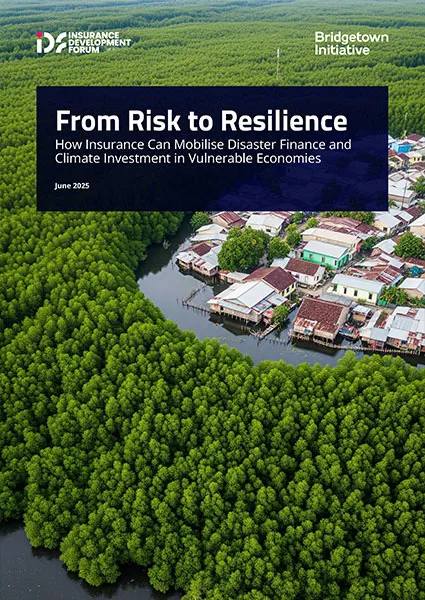
London, UK, 27 June 2025 – As Prime Minister of Barbados and convener of the Bridgetown Initiative, the Hon. Mia Amor Mottley, has said, “We do not get to choose the storms. But we do get to choose how we prepare.” The Insurance Development Forum (IDF) and Bridgetown Initiative Partnership today released a flagship publication, From Risk to Resilience – How Insurance can Mobilise Disaster Finance and Climate Investment in Vulnerable Economies which calls for action and collaboration across multiple stakeholders to unlock the full potential of the insurance sector and its capabilities, not merely as a mechanism for post-disaster recovery, but as a cornerstone of proactive disaster risk management, sustainable development finance and stability.
The first output from the IDF–Bridgetown Initiative partnership announced at the IDF Summit 2025, the paper also highlights the potential of the insurance sector to help mobilise between USD 100–200 billion* annually in climate finance for emerging markets and developing economies (EMDEs).
EMDEs face two critical challenges which put their development gains at risk and often thwart their ambitions for economic growth. Firstly, the protection gap for natural catastrophes; 90% of economic losses from natural catastrophes that are not insured in EMDEs. Secondly, the climate finance gap; the COP30 Baku to Belem roadmap targets USD 1.3 trillion in annual investment to 2035 to build more climate resilient economies in EMDEs.
Four Leverage Points for Scaling Impact
From Risk to Resilience – How Insurance can Mobilise Disaster Finance and Climate Investment in Vulnerable Economies outlines four mutually reinforcing leverage points to integrate insurance into the resilience, as well as wider development, agenda. It urges concerted action to take forward these leverage points and unleash the full potential of the insurance sector to help close the protection and climate finance gaps:
- EMDE Governments: Adopt integrated disaster risk management, quantifying protection gaps and integrating pre-arranged finance (PAF) into budget processes and financing strategies.
- Multilateral Development Banks (MDBs): Integrate pre-arranged finance into lending and investment frameworks, including through risk layering, contingent components, risk-transfer and shock-resilient loan instruments.
- Insurers: Expand risk management offerings to incentivise risk reduction, and unlock insurers’ potential to deploy investments in EMDEs.
- EMDE Regulators: Design EMDE regulatory frameworks to encourage experimentation, facilitate inclusive insurance models, and align with international standards for innovative solutions.
Commenting on the paper, launched during London Climate Action Week, Prime Minister Mottley said: “When used effectively, insurance is far more than a payout mechanism. It is a core piece of economic infrastructure that underpins investment, helps stabilize budgets, and enables long-term resilience planning. Given their sheer potential, the proposals outlined in the paper must serve as a springboard for action. Vulnerable countries must lead, but we need a decisive step-up from those with the greatest responsibility.”
Michel Liès, Chair of the IDF Steering Committee and Chairman of the Board, Zurich Insurance Group, said: “The leverage points outlined in the paper are not theoretical. They are actionable. And they are urgent. The insurance sector – when aligned with public purpose – can become a foundational pillar of a more resilient and just global economy.”
The new publication builds on an extensive body of work, and insights from both public and private sector experts. It was developed with support from the Government of Denmark through its Ministry of Foreign Affairs, as part of its commitment to a wider set of priorities aimed at providing assistance in the development of critical analytical work that can inform its wider strategic engagement, and from the Quadrature Climate Foundation, an independent charitable foundation working to build a just, equitable, and low-carbon world.
Delivery on the actions proposed in the paper will require coordinated and sustained implementation. The IDF and Bridgetown Initiative Partnership will take these recommendations forward and seek committed partners from country governments and development finance institutions to champion their implementation.
*Analysis and calculation by Systemiq.
– ENDS –
Notes for Editors
About the Insurance Development Forum (IDF)
The Insurance Development Forum (IDF) is an industry-led Public-Private Partnership bringing together insurance industry leaders, government officials and international organisations.
Launched at the UN Conference of the Parties (COP21) Paris Climate Summit in 2015, the IDF looks to leverage the technologies, expertise and financial mechanisms native to the insurance industry to enable disaster vulnerable nations, economies and populations to build risk understanding and enhance resilience.
About Bridgetown Initiative
The Bridgetown Initiative is a global campaign that advocates for the transformation of the International Financial Architecture (IFA) to better address the urgent needs of climate-vulnerable countries. Spearheaded by Barbados and supported by a coalition of nations, institutions, and experts, the initiative focuses on unlocking new sources of affordable finance, reforming outdated financial rules, and mobilizing resources for climate adaptation, resilience, and sustainable development. It champions solutions such as debt relief, concessional finance, and climate resilience investments, with the aim of creating a fairer, more inclusive financial system capable of addressing the challenges of the 21st century. For further information, please visit: www.bridgetown-initiative.org